
DIY Altoids Tin Fishing Kit: Build Your Pocket Fishing Kit
Turn a simple Altoids tin into a DIY pocket fishing kit. Step-by-step guide to packing hooks, line, sinkers, and lures in a compact kit that fits in your pocket

DIY Altoids Tin Survival Fishing Kit
An Altoids tin might seem like a candy box, but in survival and everyday carry circles, it’s a classic. The tin is tough, waterproof with a little tape, and just the right size to fit in your pocket. That makes it the perfect home for a compact fishing kit.
If you’ve never built one before, don’t worry—we’ll walk through it step by step. By the time you’re done, you’ll have a pocket kit ready to help you catch food anywhere you find water.
This is where a solid Survival Fishing Kit can be a great addition to your bag. A small survival fishing kit like the one I'm about to show you is easy to carry in a clothing pocket or any type of bag. And the best part is, it has the capability of catching much larger food than you could carry in your bag (and it can keep producing food for you long-term).
Check out our full guide to the different types of EDC Kits

Step 1: Choose Your Container
For this kit, start with a standard Altoids tin if you want maximum portability. The regular tin gives you more room for hooks, line, and extras. Pro tip: wrap the outside with duct tape or electrical tape. It keeps water out and gives you bonus cordage for repairs.

Step 2: Pack Your Hooks
Hooks are the foundation of any fishing kit. They’re what actually catch the fish, and without them your line is useless. In a survival situation, an assortment of steel hooks in multiple sizes and multiple uses gives you better odds no matter what’s biting.
-
Beginner Option: A small assortment of steel hooks in different sizes covers everything from bluegill to bass.
-
DIY Option: Safety pins, thorns, sharpened wire, or bent and sharpened paper clips will work in an emergency.
-
Upgrade: To maximize space, reusable hook cards like Grim’s Fishing Cards give you dozens of hooks in the space of a credit card. Cut one down and it slides neatly into your tin.

Step 3: Add Fishing Line
Line is the lifeline between you and your food. Thin line works for small fish, heavier line gives you the strength to land bigger ones. Without it, your hooks are just sharp trinkets. Grim’s Spool Micro Tool carries 50+ feet of line in the size of a AA battery. Pair it with a Cordage Maker and you can even turn plastic bottles into backup cordage.
-
Recommended: 50–100 feet of monofilament (8–12 lb test), as well as braided line (which doubles as cordage and sewing thread.
-
Compact Storage: Wrap it on cardboard, a sewing bobbin, or Grim’s Spool Micro Tool, which carries 50+ feet in the size of a AA battery.
-
DIY Options: Sewing thread, dental floss, two liter bottle cordage.
-
Natural Options: Plant cordage like nettle or inner bark fibers.

Step 4: Include Weights
Weights sink your bait where the fish actually are. Without them, your hook will often just float on the surface, and hungry fish swim right past. A couple of small weights add a huge boost to your chances.
-
DIY Options: Nuts, bolts, or washers tied into the line.
-
Natural Options: Smooth pebbles lashed with cord, or with holes drilled in the center.
-
Recommended Gear: Lead split shot or reusable steel sinkers.
Step 5: Toss In Lures or Bait Substitutes
Sometimes a plain hook isn’t enough—you need movement or shine to catch a fish’s attention. Lures and bait substitutes trick fish into biting when natural bait isn’t available.
-
DIY Options: Soda can tabs, shiny foil, paracord strands, or feathers.
-
Natural Options: Shells, carved wood plugs, or animal hair tied to a hook.
-
Upgrade: Tiny artificial lures or Grim’s Lure Cards, which pack flat and let you punch out lures when needed.

Step 6: Add a Hand Reel
Fishing with line wrapped around your hands works, but it’s messy, uncomfortable, and can result in severe injuries. A hand caster gives you more control, helps you cast farther, and makes it easier to pull in a fish without tangles.
-
DIY Reel: Carve a notch into a stick or wrap line around a small plastic bottle. Both work in a pinch.
-
Compact Reel: Grim’s Hand Caster Card is as thin as a credit card, and doubles as a hand caster, giving you reach and control without adding bulk.
-
Why It Matters: With a hand reel, you can throw your line farther, keep it tangle-free, and fight a fish with more control than bare hands.
Step 7: Pack Useful Extras
The basics will get you fishing, but a few extras make everything smoother. These tools save time, reduce frustration, and make it easier to go from hooking a fish to eating one.
-
Swivels & Snaps: Prevent line twists and let you swap hooks or lures fast.
-
Knife or Micro Tool: For cutting line, prepping bait, and cleaning fish.
-
Foil or Small Bag: For cooking or storing your catch.
-
Snare Wire – Doubles as trotline rigging.
-
Fine Cordage – For improvised gill nets.
-
Emergency Bait – Commercial bait pellets or attractants sealed in a straw or capsule.
Step 8: Organize & Seal Your Kit
-
Lay hooks and lures flat on the bottom.
-
Add line on its spool or wrapped card.
-
Drop in weights and swivels in a mini baggie.
-
Slide your hand reel inside.
-
Wrap the tin with electrical tape to help waterproof it and add durability.
Step 9: How to Use a Survival Fishing Kit
Owning a kit isn’t the same as knowing how to use it. Head to a pond or stream and actually fish with your Altoids tin setup. Practice tying knots, casting with a hand reel, and catching fish on improvised bait. The first time you open this kit shouldn’t be in an emergency—it should already feel like second nature.
When you’ve practiced, your Altoids tin isn’t just a box of parts. It’s a proven tool that can put food on your table when it matters most.
- 1. Pick out your preferred fishing kit here.
- 2. String up your hand caster:
I prefer using braided fishing line for my survival fishing kit (see my favorite line here). It casts easier and farther than monofilament since it doesn't hold the shape of what it has been spooled onto. You can also use braided fishing line for traps, sewing repairs, etc. - 3. Attach your weights, lures & fishing hooks to the end of the line.
- 4. Unstring a couple of yards of line and throw your lure/hook(s) into the water as far as you can.
- 5. Gently pull the line back to you (in a motion that resembles the "tug of war" game). Be careful to manage your line as you pull it back so it doesn't get tangled.
- 6. If you get a bite, be patient until the fish fully commits to your lure. Then lift your line above your head and pull back to set the hook.
- 7. After that, hopefully you have a fish. If not, cast until you do.
- 8. When you do catch something...Simply clean your fish, make a fire and cook over the coals.
Survival Fishing Kit Contents List
My personal EDC Survival Fishing Kit is really simple, I'll drop the contents below:
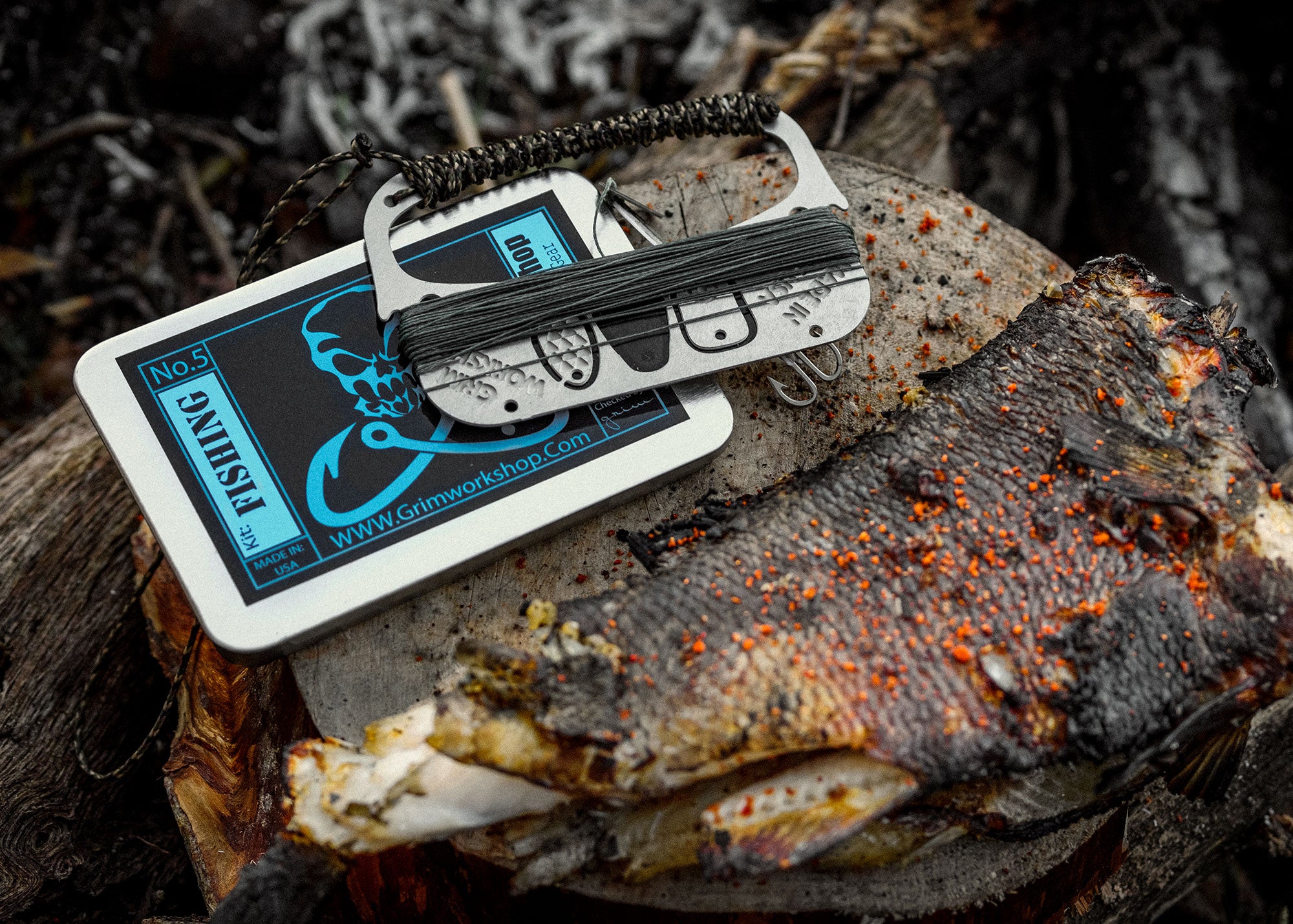
- Hand Caster Card with Spiderwire Stealth-Braid 40lb fishing line (more about this line down below)
- Specialty Hook Card
- Lure Card
- Slim Steel Tin
- Bobbers:
I keep a few of these quick-disconnect bobbers in my bag (they easily attach and disconnect without having to cut your line) - Hand Caster Modification with Atwood MicroCord:
I've slightly modified my caster with a cordage wrap so it's nicer to hold. I also left a small loop that I can wrap around my wrist so I don't accidentally toss my casting card into the water while I'm using it. (spare cordage is always a bonus too)

Why carry a Survival Fishing Kit?
I have made it a habit to carry a small survival fishing kit in my bag this entire year. This certainly could come in handy for securing food if I find myself in a survival situation. But, let's just talk everyday life for a moment...
Have you ever been out and found that perfect fishing hole, only to remember you don't have your fishing gear with you? Yeah me too, it's frustrating...I've been there many times before I started carrying a small fishing kit that can double as a survival fishing kit with me.
I, now, love having peace of mind that I can fish in any creek or pond as I come upon it. This fishing kit is such a lightweight addition to my overall kit that I don't even remember I have it with me. That is, of course, until I see some water and have time to make a few casts.

Different Size Options for Fishing Kits
Fishing kits don’t need to be big or complicated to put food on the line. You can scale them to fit your carry style, from a full pouch with everything you need down to a wallet kit that disappears in your pocket. Here are some popular sizes and why they work:
- Pouch Fishing Kit – A full-sized setup with line, hooks, sinkers, lures, and extras. Great for bugout bags, long trips, or keeping in the truck. ↗
-
Altoids Tin Fishing Kit – A time-tested survival hack. Compact, sturdy, and customizable with hooks, line, swivels, and even a few small lures. ↗
- Small Fishing Kit – Palm-sized containers that can hold line, hooks, bobbers, and bait. Enough to get you started without weighing you down. ↗
- Micro Fishing Kit – Ultra-compact tools like Grim PAKs or micro hooks and line wrapped tight on a spool card. Disappears into a pocket until you need it. ↗
- Necklace Fishing Kit – Wearable tools like Grim Workshop’s Dog Tag Fishing Card let you carry hooks, line, and small rigs around your neck for instant access. ↗
- Keychain Fishing Kit – A tiny capsule loaded with hooks and line, or a micro hand caster clipped to your keys. Light, simple, and always with you. ↗
-
Wallet Fishing Kit – Flatpack gear like Grim Survival Fishing Cards slide into your wallet. Dozens of hooks, lures, and even small saws in the space of a single credit card. ↗
Grim Tip Cards Waterproof Pocket Guides
Grim Tip Cards go hand-in-hand with fishing. Each waterproof, credit card sized guide is packed with quick, practical info on knots, rig setups, bait choices, and fishing techniques. Slip one into your wallet or kit and you’ll have the knowledge to turn line and hook into dinner. Imagine pulling out a card that not only survives the rain but also teaches you the knot you need to land a fish—it’s like having a pocket-sized fishing buddy.
The process of using a survival fishing kit is very simple, highly enjoyable and could certainly provide for you in a survival situation.
Shop for Survival Fishing Kits Here


About The Author
Based in the Appalachian Mountains, Anthony is a commercial photographer and avid outdoorsman. Whether he's setting up a scene for a photograph or getting things ready to camp, Anthony feels most at home with mud on his boots and a warm campfire burning nearby. Learn more at AnthonyAwaken.com